Colaboradores

Mostrando entradas con la etiqueta Deportes. Mostrar todas las entradas

miércoles, 12 de junio de 2013

Soccer star Messi accused of four-million-euro tax fraud

Barcelona’s public prosecutor for financial crimes on Wednesday presented a lawsuit against soccer player Lionel Messi for allegedly defrauding the Spanish tax system of over four million euros.
The Argentinean star’s father, Jorge Horacio Messi, has also been cited in the charges, which relate to a failure to declare part of the star’s earnings from his image rights in tax declarations made between 2007 and 2009.
Messi, who will be 26 years old later this month, has denied committing any infraction. “We have always attended to all our tax obligations following the advice of our financial consultants, who will take charge of clearing up this situation,” read a statement on his Facebook page.
Over those three years, Messi obtained “significant earnings” for transferring his image rights to third parties. He should have declared these to the Spanish tax authorities, but never did in all that time.
According to the suit, it was Messi’s father who came up with the alleged tax avoidance “strategy,” which the player “ratified” when he turned 18. The scheme purportedly revolves around “pretending” to transfer the Barcelona player’s image rights to front companies in the tax havens of Belize and Uruguay.
The setup, said public prosecutor Raquel Amado, allegedly allowed Messi’s earnings to be transferred from the companies paying for his image rights to the tax haven-based businesses without being subject to barely any tax and without the knowledge of the Spanish tax office.

lunes, 10 de junio de 2013

Villarreal earns promotion back to Primera

A year after it found itself relegated from the top flight of Spanish soccer, Villarreal bounced straight back to Primera on Saturday.
The Yellow Submarine secured second behind Segunda champions Elche with a 1-0 win over Almería at El Madrigal. Jonathan Pereira's 54th minute strike proved enough to dispatch the third-place Andalusian team, which had gone into the match level on points with the Castellón side.
Club president Fernando Roig can take much of the credit for enabling the 2006 Champions League semifinalist to climb back out of the hole it had dug for itself. Two days after his team was relegated last year, he decided to sell his 2.5-percent stake in supermarket chain Mercadona, valued at around 71 million euros, and use the funds to clean up the club's accounts and remodel the team.
However, the search for a coach began tragically when former Sporting Gijón boss Manolo Preciado died of a heart attack as he was about to be presented as the chosen candidate. Youngster Julio Velázquez stepped into the vacant position, but with Villarreal languishing mid-table at the halfway stage he was replaced by Marcelino García Toral whose alterations have now catapulted the team back into the top tier.
Almería now heads into the playoffs where it faces Las Palmas, while Girona plays Alcorcón in the other tie. Both first matches are due to be played on Wednesday with the second legs on Saturday. The winners will then battle it out for the final promotion spot.
At the other end of the second tier, Murcia provisionally avoided the drop to Segunda B with a 1-0 win over Las Palmas. Last week the Professional Football League (LFP) announced that Guadalajara would be relegated due to irregularities in the process of capital increase carried out by the club last year. Thus Murcia, Racing Santander and Huesca all had an unexpected final chance to save their skins on the final weekend.
Guadalajara has said it will contest the LFP's decision.

Nadal rewrites the history books at Roland Garros

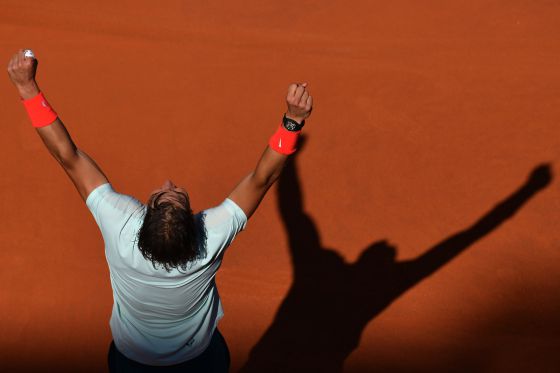
Neither rain, a court invasion nor the very best that David Ferrer could muster prevented Rafael Nadal from writing a new chapter in the history books in Paris on Sunday. The Spaniard’s straight sets win over his Davis Cup teammate made him the only player in history to win the same Grand Slam eight times, and his 6-3, 6-2, 6-3 victory was his 59th at Roland Garros, another record. Nadal has only been beaten once in nine years on the Paris clay, when Robin Söderling achieved what nobody else had before or since in the fourth round. A record of one win in his previous 16 matches against Nadal going into the final did not bode well for Ferrer.
Indeed, the score line does not really reflect the contest. Nadal was made to work extremely hard by his opponent and by damp conditions in the French capital, which did not lend themselves to the champion’s heavy forehand top spin. Ferrer had not lost a set coming into the final and displayed the resilience that is his own trademark early on when an early break brought up 2-1 and harrowing images of last year’s semifinal, in which Nadal thrashed his countryman for the loss of just five games.
But Ferrer broke back immediately and unveiled part of his game plan in doing so — to attack everything that Nadal left slightly short, go for the lines and come to the net when necessary.
Although Nadal broke again later to claim the first set, the match statistics show something close to parity in break point opportunities — 13 for Ferrer to Nadal’s 16 — but merely carving out the chances is a mammoth task against the Mallorcan in Paris. Ferrer was able only to convert three but even in the second set his tenacity could be measured in numbers. Few 6-2 partials take almost an hour to complete.
Despite the best on-court efforts of Ferrer, it took a masked, shirtless protestor invading Philippe Chatrier to break Nadal’s concentration. The world number four was unable to serve out the second at 5-1 but then regained his composure and added Ferrer’s next service game to the dusting of red brick on the main show court, taking the set with a crushing break to love.
The third began in much the same way as the first, both players exchanging breaks as the drizzle continued.
At 2-3, Ferrer was distracted by a sneeze from the crowd behind him during his service action, staring icily at the perpetrator before displaying sang-froid to hold for 3-3. But that was the last game he would claim as Nadal broke again in game eight to serve for the match. It was the champion’s turn to be unamused when the crowd got a little ahead of itself at 40-15 but a signature thumping serve and forehand combination sent Nadal to the floor for the eighth time on Philippe Chatrier in nine years.
It was the culmination of a comeback from seven months on the sidelines that had been tailored to deliver Nadal to Roland Garros in as close to top shape as possible. If it had seemed the Spaniard would struggle with the five-set format after so long on the sidelines when Daniel Brands relieved him of a pair of sets in round one, Nadal’s epic semifinal with Novak Djokovic was proof that he is back at the peak of his powers.
On clay, whether it be Monte Carlo (eight titles), Rome (seven), Barcelona (eight) or Paris, there is every sense that the ambidextrous Nadal could well try a new trick at this rate: the first player to win the same tournament with his left and right hand.
Nadal must now be considered the greatest clay-courter in history. With 12 Slams under his belt he stands third in the all-time list alongside Roy Emerson, two shy of Pete Sampras. The king of clay should also now be mentioned in any discussion regarding the greatest player on all surfaces.


jueves, 23 de mayo de 2013

Nadal thrashes Federer to claim seventh Masters title in Rome


Rafael Nadal outmuscled Roger Federer in the final of the Rome Masters to record a seventh title at the last major clay-court test before Roland Garros. On the evidence of the past two major tournaments in Madrid and the eternal city, there seems to be little to prevent the Spaniard sweeping to a staggering eighth victory on the clay of Paris next month. Few can keep pace with Nadal in the three-set format; those that can genuinely challenge over five can be counted on less than one hand.
David Ferrer ran his compatriot close in Madrid and Rome, while Ernests Gulbis came out swinging to take the first set of the quarterfinal match from Nadal 6-1. But when faced with top-10 opposition in the past three weeks the Spaniard, whose Rome win was his 41st clay title, has not been found wanting.
And all this — eight tournaments contested, eight final appearances, six titles — from a player who warned it would take some time before he was back to his best after a seven-month injury layoff.
Federer was out of sorts on Sunday, spraying 15 unforced errors around the court in the first set, which he ultimately ceded 1-6 with a routine volley placed long. A mini-rally in the second set saw the Swiss claw his way back from 1-5 to 3-5 after losing nine games on the trot, with Nadal’s serve broken for the only time in the match, but it only delayed the inevitable as the Spaniard served out on the second attempt.
Nadal now holds a 20-10 career record against Federer, with the world number four leading 14-6 in final meetings.
“It hasn’t been my day,” observed Federer. “It has been more Rafa’s day, something that happens quite often on clay.”


miércoles, 10 de abril de 2013

Should cyclists be forced to wear helmets in Spain's city centers?


"This is the first day that I've ever worn a helmet. It seems a bit ridiculous to me." This was just one of the reactions recorded by EL PAÍS on September 2, 1992, the day after it became mandatory for moped users to wear head protection.
"The history of road safety is paved with this dilemma: frontseat safety belt, backseat safety belt, motorcycle helmet, moped helmet... There is not a single prevention measure that has been favorably received by everyone," explains María Seguí, director general of Spain's traffic authority, the DGT.
And so, not surprisingly, the issue of obliging cyclists to wear helmets within city limits is not without its dose of controversy either. Several sources within the DGT have indicated that this measure, along with a maximum speed limit rise from 120km/h to 130km/h in some areas, are the two main sticking points preventing new road legislation from being passed.
The draft law includes an article that would force cyclists to wear helmets within cities, a proposal that has met with a chorus of disapproval from cycling associations and all of the political parties in the city of Barcelona.
Yet by cross-referencing data from local police forces and the Civil Guard, it has emerged that 20 percent of cyclist fatalities and injuries in cities and on roads were caused by head trauma - although the reports do not specify whether or not the victims were wearing helmets.
"The evidence regarding the usefulness of safety helmets in reducing the chances of head injuries is unquestionable," says the DGT director. "There are more than 150 scientific articles on the subject, and no cycling association is going to criticize that."
The issue, it seems, is not whether the safety helmet is useful or not, but the simple fact that it is going to be made compulsory.
"When you keep a measure voluntary, the people who protect themselves are the ones who had greater awareness to begin with. And by definition these are the people who were statistically less likely to have an accident anyway," says Seguí.
But cycling associations believe that the message being sent out by the DGT, at a time when bicycle use is on the rise, is that this is a dangerous means of travel. Statistics, they claim, prove the opposite.
"There is a yearly average of 15 deaths," says Manuel Martín, technical director of pro-cycling association ConBici. "In 2011, the last year with consolidated figures, 12 cyclists died within city limits, which means that this is a totally disproportionate measure that hinders the expansion of cycling."
According to the Annual Bicycle Barometer, around three million people use a bicycle almost on a daily basis in Spain.
"Normalcy in the use of the bike will be affected by the imposition of safety helmets," claims Martín. Comfort and esthetics are two factors, he says. "Think of a woman who has just come out of the hairdresser and has to put it on," he says.
Elsewhere in Europe, helmet use is not compulsory, according to the Association of Professional Cyclists.
The ConBici spokesman calls the measure "paternalistic" and notes that "around 300 people drown every year yet it is not mandatory to wear life vests in reservoirs. If the traffic authority is so worried about the health of all citizens, it should start by making car occupants wear safety helmets, since every year there are around 5,000 victims of accidents, including fatalities and injuries, many from head and brain injuries.
Yet the cycling accident figures are incomplete, says María Seguí, because "they are the same ones that the DGT handles, and by law they only reflect accidents involving a motor vehicle."
Seguí admits that in any case, the cyclist fatality figure is not high, and that "what really kills cyclists is the speed of the vehicles, thus the importance of slowing down within cities with the new road regulations [30km/h or 20km/h, depending on the size of the road]. This will be the main way of helping cyclists."
Her main concern, she says, are injuries. In 2011, 285 riders were seriously hurt within cities, the highest rate since 1997. "Brain damage is a silent problem in Spain," insists Seguí, underscoring that helmets reduce both the number of injuries and their severity. In 2012, she explains, there were 5,600 cases of brain damage and more than 200 cases of spinal damage.
"Am I going to promote a means of transportation that could result in more brain injuries when I have a tool that I know is effective in terms of their reduction?" asks Seguí.
But cyclists argue that the DGT and the Interior Ministry "legislate on the strength of perceptions" and that they lack studies to back up their claims, according to Manuel Martín, who points to another study: "In New Zealand it was proven that bicycle use fell 30 percent after helmet use was made compulsory."
Seguí is aware of that study, but notes that it was conducted immediately after the new legislation went into effect. "Nobody has followed up on it in the long run, and people who are fans of using bicycles come back to them sooner or later."
There are scientific studies backing the effectiveness of the helmet as a protection measure as well as the effectiveness of making helmet use compulsory. A Canadian study published in the magazine Injury Prevention says that there was no significant reduction in bicycle use when helmets were made mandatory in Canada.
But Seguí remains committed to her plan. "If they want to throw tomatoes at me," she says, "let them throw them."


sábado, 9 de febrero de 2013

Nadal back in swing with victory


Rafael Nadal made his long-awaited comeback in a singles match on Wednesday in Viña del Mar and more than the result, the world number five, who has been sidelined since Wimbledon last July, was happy with the way his knee responded to a competitive match.
“For now the most important thing is to spend as much time as possible on court. This victory allows me to play at least two more matches, singles and doubles. To practice is one thing but to play is totally different. In a real match you can’t control your body as you do in training,” said the French Open champion after a 6-3, 6-2 victory over Federico Delbonis.
There was a touch of rust in Nadal’s play as he dropped the first two games but the Spaniard swiftly found his range and movement to rattle off 10 of the next 11 before his Argentinean opponent recovered to claim a couple of games in a one-sided, 38-minute second set.
Nadal was scheduled to play again on Thursday in the doubles competition with partner Juan Mónaco, the world number 12 who was surprisingly dumped out of the singles draw by Guillaume Rufin. The unseeded but potent pairing was up against Rufin and Filippo Volandri.
In the singles Nadal awaits the winner of an all-Spain clash between Albert Montañés and Daniel Gimeno-Traver in Friday’s quarterfinals.
Of his long return to fitness and prospects for the year, Nadal was both optimistic and belligerent. “I want to get back to the player I was before and, genuinely, I believe I can do it,” he said. “If my knee is okay, what reason is there for me not to do it? I’ve been in the top two for eight years. I dare to say that in eight months I haven’t forgotten how to play tennis. It’s true I won’t be the favorite in Paris, but I don’t need to be the favorite to win it.”
Nadal also challenged the concept that a new Grand Slam final rivalry to replace his lengthy duel with Roger Federer was taking shape between Andy Murray and world number one Novak Djokovic. “I’m only a year older than them. I don’t think it’s the time to bury me right now. Eight months ago I was in a good position to be world number one. We forget very quickly. Now I have to try to get myself into the Djokovic-Murray era.”
Nadal attributed the Serbian’s excellent form to his physical durability: “He can do what he wants and he never gets injured. Give me two years without injury, and...”
Responding to comments made by Belgian former player Christophe Rochus earlier this month — in which he essentially accused Nadal and Robin Söderling of using their layoffs to cover for doping — the Mallorcan replied: “They’ve tested me nine times while I was sidelined; not bad for someone who wasn’t playing.”